
Why Certifications Help to Assess Talent
Some people don’t like Salesforce certifications and argue that only real life experience shows true skills, but I think certifications are a good data point to look at and they show a lot about the person in addition to their abilities. Salesforce certifications give a second angle to what makes up a person’s skills, it allows time experience on one axis and credentials experience on the other. Even this is a far too simplified view of people but it’s much better and more helpful than evaluating people based on time experience alone. Time is an imperfect measurement, since not everyone is as skilled as each other regardless of time and everyone learns at different rates. Salesforce certifications make it possible to close the knowledge gap in areas of your Salesforce abilities without having to spend years and project hours, and while real world experience is beneficial in evaluating talent, it is more helpful when evaluated alongside certifications and other credentials as well.
I’ve talked to dozens of consultants across multiple Salesforce implementation partners, ranging from those just coming into the company with no Salesforce experience to the senior architects who are brought into all the toughest new projects or derelict projects that have gone off the rails. Views on certifications are anything but consistent. Some experienced or management individuals caution about the risks of relying too much on credentials like Salesforce certifications. The tests are, after all, written exams that can be passed by studying without getting real world experience or necessarily committing the information to long term memory. This ability to not fully learn or understand the concepts could create a high volume of unqualified certification holders, who are pursuing certifications for the purpose of career and —presumably— monetary purposes without trying to deepen their platform and consulting knowledge. I do agree that this could present a subset; however, I think excluding everything due to the results of a small subset is too hasty.
Time on the job isn’t a perfect measurement, and sometimes people who have been in that position longer can even be less desirable than newer people who have reached that same level more quickly. In the Salesforce ecosystem specifically, there’s a big difference in how years of experience benefits you for any given position. Between working as an internal admin, working as an ISV admin, and working at a consulting company, your day to day duties and learning of the platform will be different. It seems uncontroversial to say that consulting resources will encounter a greater quantity and variety of different configuration requests and scenarios than someone who is deep within the setup of a single company. People working in those consulting companies will also be surrounded by other Salesforce experts, potentially hundreds, and that collective base of knowledge is invaluable when it comes to tricky solutions or just learning a new area of the platform. Internal admins get the chance to deal with the same org’s requests day in and day out, which gives them an advantage at understanding that specific configuration and organization. If internal admins leave and move elsewhere, though, the amount of knowledge that is platform specific compared to company specific might become a challenge. Time is a very helpful evaluator, but a flawed one if it’s looked at alone—enter certifications as a cross reference.
Certifications present a second objective metric in addition to years of experience, allowing a cross comparison of individuals and expertise. The certification program not only creates a way for hiring companies to view areas of expertise but also creates a clear path of career progression for those looking to deepen their skill on the platform. Yes there are ways for unqualified people to get certifications, but there are also a lot of excellent resources for people who genuinely want to learn the platform to deepen their understanding and then test that knowledge with a test created by Salesforce itself. Yes, some of it is rote memorization or things you would ordinarily just Google to get the answer to in a second, but does that mean it isn’t valuable to learn the information and validate your knowledge?
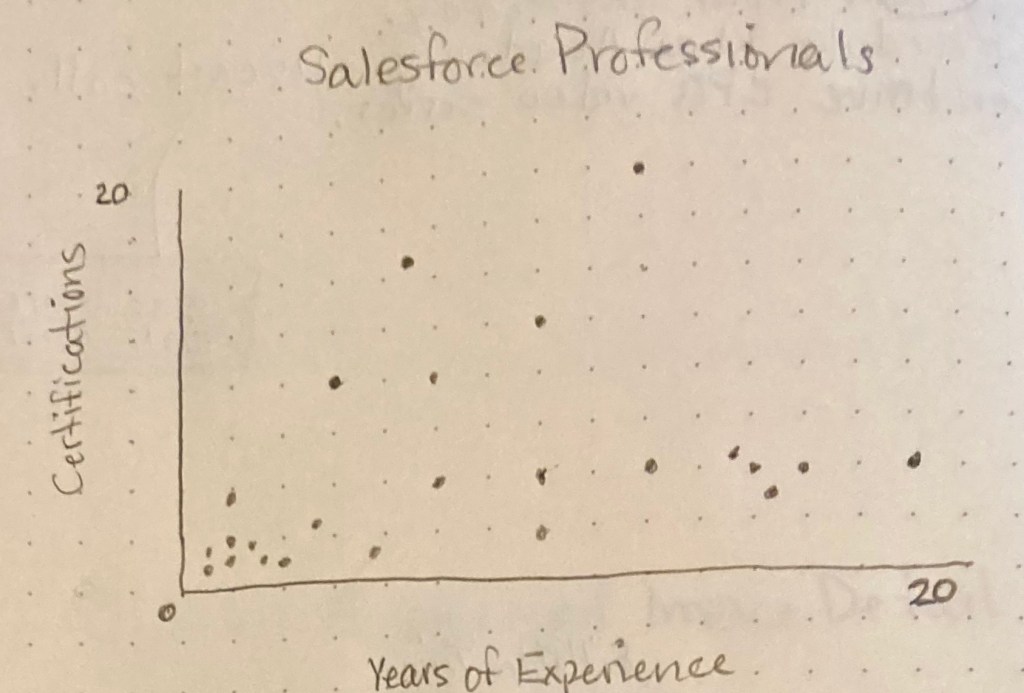
Certifications and time are the two easiest quantitative measurements to gather and use to evaluate people before you’re able to speak with them about their experience. Talking to someone about their specific experiences and skills is amazing, but in order to set up sustainable processes you need a reliable way to limit the amount of time spent having those conversations. Use certifications and time to determine an initial assessment, and then have conversations with those who possess an adequate mix of both. Ask about the experience, both time and certifications, and how they’ve approached learning in both. Just like how a more well rounded view of quantitative measures benefits an immediate evaluation, adding in the conversational–qualitative–evaluation will create the best all encompassing evaluation.
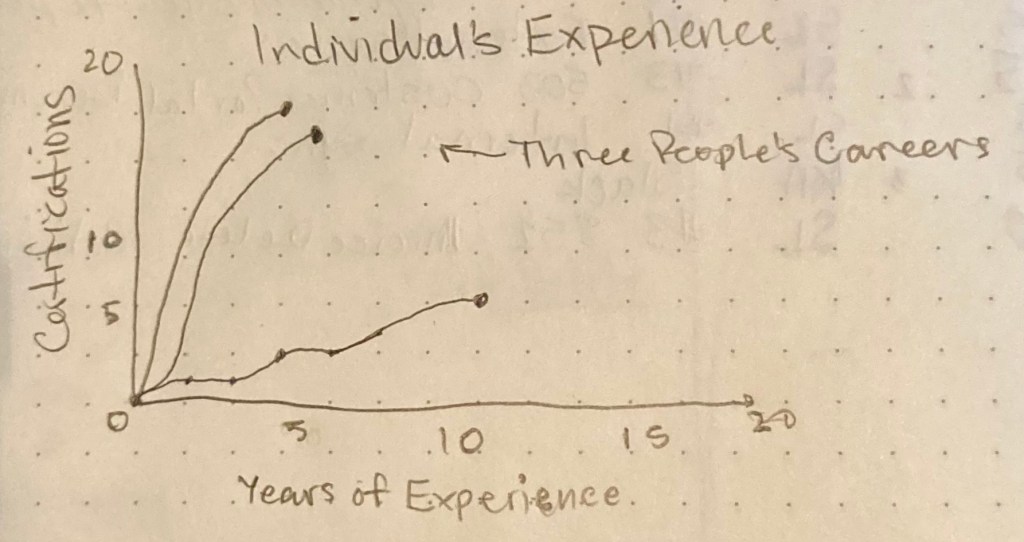
When it comes to evaluating the usefulness of Salesforce certifications, I think it’s important to think about all aspects of what they could say about someone. Other than the drive to get such credentials, pursuing certifications over the course of your years of experience gives insight into one’s desired pace of learning and career progression. The specific certifications someone gets signals the kinds of things they’re interested in and have experience with, as well as where they might want their career to go. Using time experience in addition to certifications is a great way to get even more insight. Where do all these candidates fall on a chart of certifications by years of experience? What does the timeline of this person’s year of experience look like charted by the number of certifications they’ve acquired? What are the most recent areas of interest according to a person’s certifications? These questions and many more can be answered in the recruiting, retaining, and promoting pipelines if you actually give weight to certifications in addition to years. Either alone is a very flawed evaluation of a person but together they can compensate for the downsides of either individual one, and any remaining flaws can be resolved through actual conversation with the individuals.
 The Declarative Architect